Saturday, 13 May 2017

To Share or Not to Share: A Story of the Web, Fake News & Africa

“To remain the web’s weavers and not its ensnared victims, we must merge with our electronic ‘exocortex’, wiring greater memory, thought processing and communication abilities directly into our brains.”Hughes, James (18 November 2006). “What comes after Homo sapiens?”
Today while I searching for a term on my Google app, I noticed an extraordinary news item prominently displayed under the search bar. Its headline reeked of the usual sensationalism you’d expect from modern media outlets and, had it not have anything to do with a fellow East African Nation, I probably would have ignored it.

The Piece of Fake News link I Encountered. Nothing screams for attention more than “Breaking!
But it was too distracting and important a headline to ignore. A quick search helped confirm suspicion; this was most probably fake news being peddled by an unscrupulous website that doesn’t mind publishing pure junk for the ad revenue.

If you’re not familiar with the subject of the headline, here’s the short version: South Sudan, the world’s newest, independent country, has a president from the ruling Sudan People’s Liberation Movement (SPLM) party called Salva Kiir. He’s currently locked in a bitter rivalry with his own vice president named Machar. This internal strife has cost the country dearly ever since.

Regardless of how you feel about all this, news of the president’s death, given the situation and the nature of ethnic-based conflicts, would be a big blow to the country, nullifying any remote chance of peace for the foreseeable future. People sharing this online can potentially do irreversible damage to the country’s already delicate situation (perhaps it is of small comfort that most of the country’s impoverished citizens might not actually see this news piece).

Unless we do things differently, like what I did immediately after discovering that this was fake news.
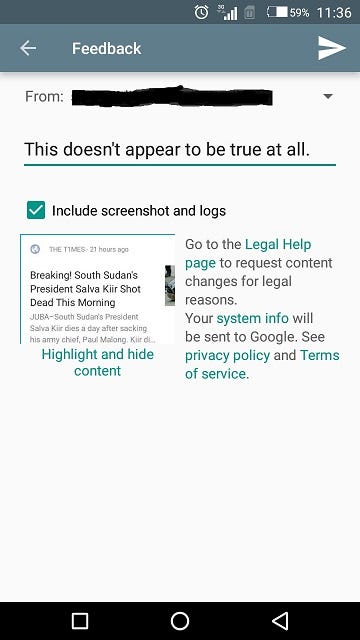
To Fake to Share. I hope Big G still listens to feedback
To be honest, this does not change my personal stance on the general subject of fake news; fake news is a part of humanity and that will never change. It exists on all sides of the spectrum. What can change is how each and every one of us RESPOND to any news item we encounter wherever we are on the web. We should not get so easily caught up in our own web. If we are going to prosper in our web of information, WE THE USERS must learn to navigate it well. We must invest ourselves in keeping our web clean and healthy before we start asking corporations and institutions to keep it clean for us.

The tools already exist for this to happen. All we need now is to inculcate in ourselves the mental discipline needed to use these tools. If every human knew how to identify, verify and filter fake news from real news with an accuracy of 100% (assuming that is even theoretically possible given the constraints of the human brain), we’d never have to worry about a clickbait news sparking a civil war. And it can all start with a simple act, like not sharing a faulty news piece.


Saturday, 29 April 2017

Algorithms & Intellectual Inbreeding: Why We Must Emancipate Our Minds


We are spinning an algorithmic prison around our minds
This post was was inspired by one of Caitlin Johnstone’s commendable essays where she noted (as have I) that Medium’s “…‘recommended-for-you-based-on-your-interests’ feature has no idea how to even deal with people like me”.
When you stop learning, you’re dead. And learning only happens when you taste the elements. You learn when you suffer contact. And when you expose yourself to something as diverse as reality, you can only become intellectually stronger. You see more, you know more and unlearn more.

When you harbour a “ conviction” on the other hand, you raise a ‘truth’ above and beyond all reasonable discourse and raw, unflattering debate. Such is the nature of religions; they demand subservience to a higher power that is beyond ANY kind of reproach. This isn’t a healthy environment to perform an inquiry of any sorts. This is an echo chamber made temple. And we have plenty of temples today, shaped by our recommendation algorithms at Facebook, Youtube, Amazon and many others. Our minds are slowly being enslaved by the algorithms.

The creation of the scientific methodology, reasoning and logic was supposed to help us “find the truth” about the mysteries of reality. And yet, in this era of the algorithmic society, we see the creation of reasoning aids that lock us deeper and deeper into barren thought temples of our own making. And we unabashedly relish this, knowingly or otherwise.

The computer and the world wide network envisioned by past and present pioneers were supposed to increase accessibility to information, to assist in the exploration and synthesis of new ideas. While that has largely happened, it has also led to the creation of our “monsters from the id”.


There is a whole world to explore outside your intellectual pen
We are increasingly being cornered into our own, individual ways of thinking; it is perhaps apt to call it intellectual inbreeding. We are increasingly bereft of crucial cross fertilisation of minds, the kind the actually kindles real understanding and insight the advances society. Imagine an academic world completely bereft of cross-disciplinary activities; siloed departments refusing to share info. Where would be today? But that’s exactly the kind of society our algorithms are crafting for us today every time they show us what we might like, tweet or talk about next based on our flawed “beliefs”. No malevolent AI needed.

The end result is frightening; whole people can no longer understand whole communities. Flame wars and real wars break out because we refuse to comprehend each other. “Cultural clashes” happen because whole communities prefer to sit in a silo of their own making. And our algorithms that run social media, and yes even Medium, help to aggravate the situation.

How can you learn about the left side of politics if you only see your own side and vice versa? How can you understand Brexit if you refuse to leave abandon the “London mindset”, if only for a short while? How can you understand the consequences of regime change in Syria if you don’t really know what the alternative entails? How can you start a war when you don’t know your enemy beyond what your own culture perceives it as?

I should not be misconstrued as advocating for hippy peace and cultural understanding. I am more concerned about our mere survival as an intellectual race; learning through suffering contact with other minds. If you don’t touch it, you’ll never get it. Likewise, if you keep reading ThinkProgress all day, you’ll never understand why your BFF voted Trump.

Emancipate your mind today. Break free of the algorithms that rule the our minds and explore the works of minds far different from yours, if only for your own sake.

Tuesday, 25 April 2017

Enter ‘Wikitribune’: A Game changer for News Writing or just ‘Meh’?

Wikitribune Campaign from impossible on Vimeo.

Remember when I talked about how the world might benefit from embracing radical openness brought about by using decentralised wikis and similar software systems? Jimmy Wales of Wikipedia fame must have had similar thoughts because today he announced Wikitribune (see the video above).

In a nutshell, Wikitribune is a wiki site for news. The initiative is currently seeking funds via crowdsourcing to hire at least ten journalists for now to write quality news pieces that people online might care about. According to the initiative’s website, ordinary volunteers from the public will be able to ‘work’ with hired professionals to write news pieces that are well sourced, fact checked and created in an open, accountable manner.

Moreover, it has been stressed that the initiative will not rely on advertisements to fund itself. Instead, there will be a monthly subscription, though it seems this subscription will be a voluntary thing because the initiative’s site also mentions that ANYONE will be able to read ANYTHING (that is, no paywalls which is a big thumbs up from me) and ANYONE will be able to flag any piece that appears to be problematic or even fix it before sending it for reviewing (presumably by the hired professionals).

So far around 3370 people have contributed to the effort with 29 days left on the fundraising clock as of the writing of this article. Having said that, there has been some incredible amount of back-and-forth happening on the great forums of the web and social media regarding this effort and even some in mainstream media outlets are throwing in their two cents which is a good thing because Mr. Wales is right about one thing in all of this:
The news is broken. So broken in fact that some might say it is beyond saving.
If you’re surprised by that last part then therein lies the problem: this is not news at all. It only seems so now because, well, it pays to say it is so (it brings in them clicks) and its good political ammunition considering current political circumstances. In fact, people have been talking about the broken nature of news since the turn of the last century and maybe even before that (I am currently reading a book titled “How the News Makes Us Dumb” by C. John Sommerville, Professor of English History, Emeritus University of Florida, published in 1995 but it might as well have been written today). Some people have become so uppity over the issue of broken news and the nature of fake news that they seem to have forgotten that humans have been producing AND listening to fake news since the beginning of civilisation itself. Modern industry turned it into a product and online advertisement made it damn cheap to produce.

However, in the end, the most fundamental problem lies in people themselves. We want to be informed; we want our news, yes, but we want it every second, every day and we want it real cheap and, most importantly, we want to feel FULFILLED by it, and not offended. Gossip works in a similar manner (Instagram and Whatsapp gossip literally determines political events on the ground where I come from), and that’s why gossip packaged as a news product sells. And that is also why we have libel laws (and why certain religions label gossip as a sin, but let it be known that I completely believe in the supremacy of freedom of speech).

So, after all has been said and done, can Wikitribune fix all this? No, of course not. If the goal is to fundamentally produce everlasting, super-mega, out-of-this-world editing wars and drama (which will be news itself and will definitely sell) between the community and the professionals, then yes, it will totally be a smashing success (I don’t know how an initial team of 10 people will be able to engage with a global-sized community of volunteers while covering stories at the same time). Otherwise, it is trying too hard to solve an unsolvable problem, kind of like how some early proponents of bitcoin tried to “replace politics with mathematics” (that turned out to be a load of 💩).

But, it may set the stage for more accountable news creation, though IMHO Wikipedia can already do this quite well in its current state WITHOUT indulging in too much news creation (we already have a HUGE surplus of the latter). I am of the opinion that all this effort could be better spent at enhancing Wikipedia’s news aggregation capabilities (and real news journalists can chip in like all the rest) and improving the site’s editing system and what not.

I love Wikis; I love what they can do and I also recognise what they cannot do. Wikitribune may very well be able to do what it says will do but it will not be able to fix a flawed industry that serves a flawed need. Consequently, the people who sign up for this should prepare themselves to question the entire endeavour eventually when the time comes, just as it happened with Wikipedia back when it was a nasty place (it sometimes still is), and perhaps change it in some way, for better or worse. It has yet to fix anything, despite Mr Wales saying that they have “figured out” how to fix the news. They are still at the very beginning of the discovery process, and there is a lot of ground to be covered before Wikitribune can claim to have solved the problem.

In conclusion, I would argue that it would be much more useful to have a wiki site that offers tools and tips on how to be a great Wiki journalist, and then set the site’s subscribers lose on Wikitribune, or Wikipedia for that matter. In fact, I think Mr. Wales should probably focus more on improving Wikipedia rather than creating something that may very well end up becoming something like a Wikipedia clone, but with the journalists doing more editing and community engagement than actual journalism, among other possibilities.

I look forward to seeing what comes out of this initiative. Hopefully we might just learn something new from it all.