Showing posts with label Exploration. Show all posts

Tuesday, 3 October 2017

The End of Cassini: Why We Must Keep Exploring

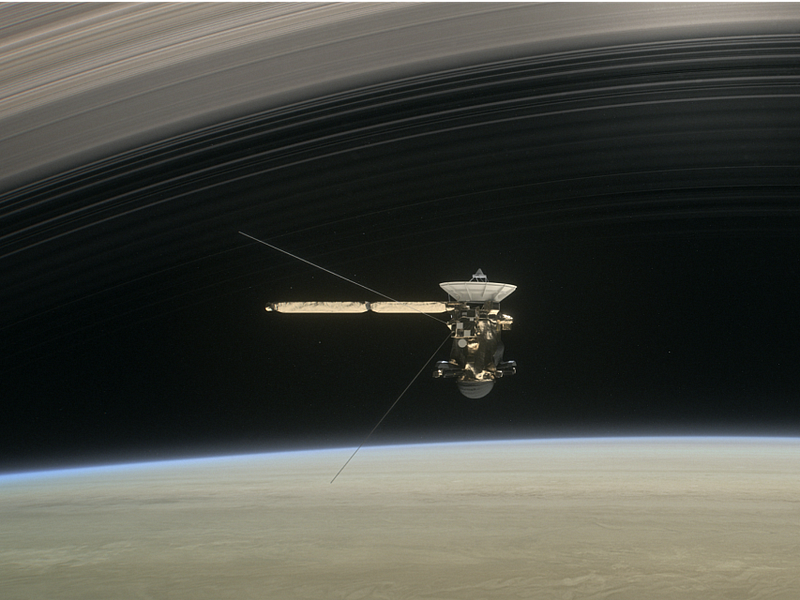
An illustration of Cassini’s “Grand Finale” at Saturn (NASA/JPL)

Semper Exploro. Always exploring. The spirit of this motto filled my heart as I watched the planned disintegration of the 20 year old Saturn orbiter Cassini unfold on social media. When the spacecraft finally stopped signalling the homeworld at 1155 UTC on September 15th, I realised that, although the mission was a resounding success, the spirit of Semper Exploro demands that we should send another probe in its place. After all, there is so much left undiscovered at the Saturnian system; what lies under the icy crust of the geyser-spewing moon Enceladus? What do the seas of Titan actually look like? Cassini has left us with even more questions than before it entered orbit in 2004 after a 7 year journey across the solar system. And those questions should be answered not merely because it is scientifically relevant (it is a given), but because the spirit of exploration which Cassini embodied and which Semper Exploro captures so well has the potential to further unite humanity and bring about the best of us in more ways than what any formal ideological framework can do. And we need a better alternative today, now more than ever.

Exploring can be a risky venture, but its a worthy risk. Indeed, an explorer’s death may be the only kind of death worthy of glorification. We stand today only because of a few men and women who risked it all stepping into the unknown in all kinds of fields. With exploration comes advancement. With curiosity comes the gifts of innovation. With ventures comes prosperity. With each expedition into the unknown comes priceless knowledge that uplifts us all as a species. How much more prosperous would we be today had we dedicated all our efforts to kill or dominate one another towards instead settling space, curing illnesses and so forth? The most logical answer would be: many times over, perhaps a thousand fold.

Film works like Star Trek that attempt to portray the future as an advanced utopia are sometimes criticised of being overoptimistic, naive and ignorant of ‘reality on the ground’. But reality is only what we allow it to be. If we want, we could have a Star Trek kind of future right now. If we want, we could have institutions whose only purpose is to explore, discover and advance peaceful prosperity across the stars. Yes, even with our severely flawed humanity we can still have our cake and eat it IF we believe we can. After all, this flawed humanity is the same humanity that has created the better present we see today. And experience can serve as a catalyst; people today are more motivated than ever to improve not just their own circumstances, but the circumstances of everyone else around them, simply because of inspired hope. The momentum created by this hopeful belief means that, for the most part, we have no where else to go but up.

We cannot hope to have a smooth ride to the future. But fantastic endeavours like the Cassini mission can help remind and solidify our global desire as a species: to see what’s on the other side of the distant horizon. To learn and grow wiser. And to do it with everyone around us.

If we can just keep on exploring, perhaps one day we might discover an even better version of ourselves than we could ever have imagined. But we must keep exploring. Semper exploro forever Cassini.

Monday, 2 December 2013

New Explorers of the Final Frontier

The new month has begun with a bang with the launch of China's latest in a series of missions to Earth's natural satellite, Chang'e 3 with its surface rover, Yuta.


At the same time India's mission to Mars, Mangalyaan, has successfully cleared Earth orbit and is now heading for Mars, a journey that will take it 300 days. Space is truly becoming a busy place; as busy as any other area buzzing with human activity but we are perhaps entering a new era of space exploration. An era where space not only becomes part of the human cosmos, but becomes an essential part for every nation in the world. And we are seeing the beginnings of such a world in the form of our global need and dependency on environmental data and space-based telecoms capability, and maybe someday soon, raw materials.

No boost to interplanetary sojourns is complete without a look back home; here's a parting shot of the Earth taken by Mangalyaan almost 10 days ago. A sort of visual salute to the land of its creators no doubt.
Earth by Mangalyaan, taken on November 20, 2013 (ISRO)
You can read details on the Indian Mars Orbiter Mission here and about Chang'e 3 here.

Sunday, 13 October 2013

The Unreasonable Unknown

Is such a voyage unreasonable?
Artist's depiction of the Voyager spacecraft.
(NASA/JPL)
In late August 2012, after 35 years of travelling through space, NASA's veteran spacecraft Voyager 1 opened a new chapter in our species' long story of exploration by crossing and consequently mapping what is believed to mark the end of the sun's sphere of magnetic influence; the heliopause for the first time.

However, due to the unknown nature of the region the spacecraft is surveying, it took the mission team almost a year since seeing the first suggestive signs of the crossing to study the data before they could confidently announce to the public that the humanity has now become an interstellar faring race. Undoubtedly, this is a remarkable achievement and event not just because we have proven that it is possible to send a craft to the distant reaches of our sun's domain but because it awakens that deep sense of the unknown inside all of us. Whenever we progress into unfamiliar territory, be it worlds, continents, life stages or situations, there is that deep, exotic feeling that one gets; a mixture of hope, awe and apprehension. We have reached the edge of what we know, now we venture into unchartered waters.

This drive to reach the edge of knowledge, for good or for ill, drove a lot humanity's doings; from the discovery of the New World by the Europeans to the exploration of the Inner Space under the seas to the venturing of humans and mechanic emissaries into space to our peering into the distances of the sky to fathom the heavenly domains. What we gain from doing all this is nothing short of meaningful progress. The very same progress that has allowed us to tame nature (somewhat) and allow us and our children to thrive and live more comfortably. As the famous playwright and political activist George Bernard Shaw once put so eloquently, "The reasonable man adapts himself to the conditions that surround him... The unreasonable man adapts surrounding conditions to himself... All progress depends on the unreasonable man". The Voyager mission, itself an unreasonable mission, is truly a work of unreasonable people!

So, we are left with the question; do we owe our comfort today to the people who accepted things as the will of the universe/deities or to the people who went about asking seemingly unreasonable questions, and then ventured out to the edge of the known to find the answer? I believe the answer goes without saying.

Meanwhile, Voyager 1 will continue gathering data on this unexplored region of sun's domain (it can still be regarded as the being the sun's domain despite the crossing because the sun's gravitational influence extends farther outwards, up until the Oort cloud where the majority of our solar system's cometary bodies reside; Voyager has yet to leave that area of influence as illustrated below) until its radioisotope thermoelectric generator stops producing power somewhere in the mid 2020s. From then on, she continue drifting further from us, a silent emissary to the stars.

Learn more about Voyager 1 and her sister craft Voyager 2 here.
Where Voyager 1 is as of 2013. (NASA/JPL)

Tuesday, 20 August 2013

Celebrating a 136 years of Mars moon discovery

Asaph Hall (Commons)
It's 136 years since American Asaph Hall discovered the Martian moons Phobos and Deimos in August 1877! Today we can now see the two moons from Earth, Mars orbit and the surface of the planet itself!

We have come a long way and we've still got loads of places to go. Like to my Mars Science Lab journal page where I've written a piece today all about the moons of Mars!

Tuesday, 6 August 2013

Justifying Space Exploration

A self-portrait of the Curiosity rover
on Mars. How do we justify this?
(NASA/JPL/MSSS)
I remember being on a family visit at one time when I was still in my early teens. We were settling down for lunch and the table discussions inexplicably veered towards the financial justification of conducting space missions by America and other countries.

The debate split the table into 2 camps for and against. Naturally, being citizens of a third world country, the latter camp was full to breaking point. Guess who was all by his lonesome self in the for camp. Moi!

I don't remember much details but what I do know is that for the first time in my life, I felt completely hopeless in the face of open scrutiny. How could an ignorant young chap justify such expensive endeavours that he doesn't immediately benefit from and yet loves as much as a young person would love, say, a rock star or a professional wrestler?

Time has passed and today America is running a one year old Mars rover. They're still spending on space exploration and still a superpower by any objective standard and we're still, *ahem* stuck in the mud. I should feel vindicated (and indeed I do) but an explanation is in order.

To that end, I have written a short reflection on this other blog of mine as a sort of delayed response to that old debate that I couldn't even hope of ever winning at the time. But we must remind ourselves that in the art of important debates, it isn't a question of winning or losing but a question of clearing the air and revealing truth. That is the sign of a true knowledge gatherer!