Showing posts with label Philosophy. Show all posts

Wednesday, 12 April 2017

Our World is Changing: How Might We Master Change?

The Libyan Revolution, an example of change gone wrong. Image shows a tank outside the city of Misrata (Wikimedia Commons)
Change is guaranteed in Nature. Matter undergoes state transitions, ecosystems suffer violent episodes and recover and your body turns over your red blood cells every 90 days.
Even aspects of our personhood are in a constant state of flux; from childhood to puberty, from adulthood to old age, what we might consider as ‘us’ never stays quite the same. We always seem to find an alien of sorts to cringe at when staring at records of our past selves.

Far from being an existential conundrum, changes in the self is evidently our most precious characteristic, imparting us a degree of adaptability that has allowed us to survive a world where Change rules supreme. Besides that, in a world where humanity is immutable in belief and structure, would we discover anything new? Would we discover that tenacious form of ‘human spirit’?

And yet, despite all this, we also happen to live in a world where change receives very mixed reception. Few of us embrace change as we would embrace life itself. Even when most people would prefer change over the status quo, there are always those who would prefer the past over the present and its futures, no matter what.

The concept of ‘traditions’, ‘customs’ and perhaps even animism evolved partly out of our natural desire to always be connected to the past. This is something to celebrate, but tradition that fails to acknowledge change tends to breed instability in the long run as pressure inevitably builds up between the forces for change and the forces of status quo.

Therefore, in a world gripped in ever morphing new challenges, it is imperative that we seek to master the science of change through the creation of “tools for mastering Change”. Our present tools and structures for managing ourselves (i.e. governments, institutions, policies, etc) thrive on creating artificial stability. They are fragile. A single parameter change can quickly and violently end things (the global debt market is but one example) and we would be left helpless and unprepared, all ripe for extinction.
Any fool can create change and the tools for manifesting change already exist; the internet is the tamer kind and modern weaponry is the deadliest of them all.
The astute reader will note, however, that I draw a distinction between tools for creating change versus mastering change. Any fool can create change and the tools for manifesting change already exist; the internet is the tamer kind and modern weaponry is the deadliest of them all. What we lack are the tools to manage and understand change. Consequently, while we can establish change amongst ourselves (revolutions, protests for policy change, lobbying) we are COMPLETELY blind as to question of what those changes might entail and how to implement them without killing ourselves in the end.

To put it simply, while it is easy for us to implement said change, it is difficult for us today to manage that change once it is out there in the wild. We are fragile, glass figures that easily shatter and shatter ourselves in the process, all in the name of unquestioned, unmanaged, undisciplined change.

Mastering change is about more than merely predicting what lies ahead (an unreliable science in the hands of fools), its about embracing change just as we would like to live a good life without becoming hurt in the process. It is about us as a species learning to drive confidently into this brave new world of ours while not under influence of our naive selves.

Monday, 10 April 2017

Good Governance Made Simple

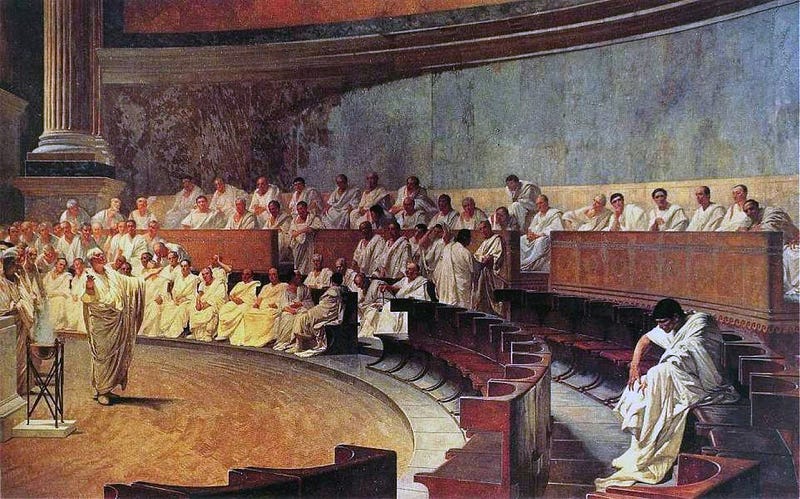
Painting depicting Ancient Rome’s Senate

I wrote this short essay on a whim: is it possible to reduce the concept of “good governance” to its most succinct components such that a severely distracted millennial could comprehend it instantly and even perhaps make something of it all? What follows is my take. You be my judge.
I remember a time when the term ‘good governance’ was being thrown around a lot. Often it was used as a placeholder for modern liberal democratic states, classically thought of as the pinnacle of human civilisation and progress. Indeed, that may be so but are all nascent liberal democracies destined to a life of prosperity? The evidence is shaky at best, non existent at worst. Perhaps it is no wonder then that the original term seems to have died a quiet death over the turn of the last decade. 

Good governance these days seems to live up there with the rest of the world’s pies in the sky. People are on the lookout for something different, if the election of Trump is anything to go by. It’s unfortunate that things have turned out this way. Good governance is still arguably important to all of us, despite the up tick in global cynicism towards institutions that can potentially support it. However, perhaps the idea is in need of rejuvenation, now more than ever, before it can become a rallying point for good, honest people to build awesome and relevant institutions again.

So, first off, what exactly constitutes good governance any way? Depending on who you talk to, good governance abides by several principles such as accountability, transparency, citizen participation, efficiency and responsiveness in giving service, rule of law, and inclusiveness. So far so good, but can we make all this any simpler? Let’s start from the perspective of people.

If people cannot natively sense that they are benefiting from an institution’s presence and activities, then the stage is all set for a reset in the form of tumultuous, revolutionary resets. The key thing then is obvious: a structure that does not serve cannot sustain its own existence, or the people who depend on it for that matter. So, through reasoning, we can conclude that defined, efficient structures that actually meet demand with all the trappings of good governance are desirable. Great!

However, structures are only as good as the weakest link in them and the weakness stems from, again, people. This weak link emerges in the form of general illiteracy and the general inability to comprehend the structure, not only for the purpose of using it, but also for the purpose of improving. You cannot make progress with a mechanism you cannot comprehend, let alone try to comprehend without access to basic cognitive support (education, open knowledge, rigorous, open public discourse, open information networks, open tools, etc).

Therefore, from the above we identify two main components that need to be in place in order to even begin to implement good governance: a defined structure that can be documented in an open manner, is agreed upon and understood by every stakeholder to the maximum, and lends itself to renewal through intelligent, informed self-amendment by ALL involved stakeholders (I default to the belief that that which may affect all must be decided by all). Structure and knowledge; these, I would therefore argue, are the very foundations of good governance at any level of human organisation.

Sunday, 9 April 2017

Free & Open Technology: A Law unto Itself & why only You can defend it

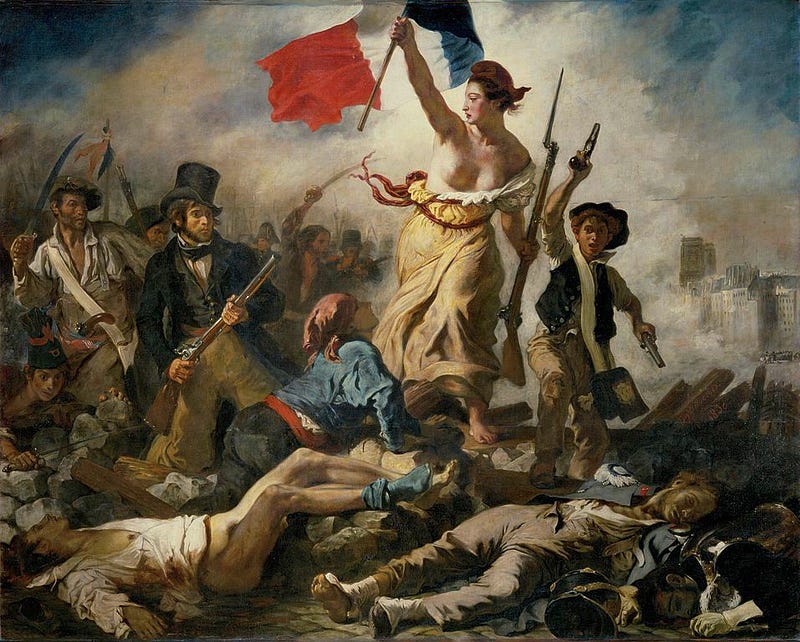
“Liberty guiding the People” by Eugène Delacroix, 1830

Hello folks, it's been a while since I posted something here. Figured it was high time I made atoned my sins and rejuvenate this blog. I have a Medium page which you can check out here. There's plenty of stuff over there but you can also stay here to look around at some of my more ancient musings. I'll try to see if I can bring this blog back from the dead. Until then, enjoy! Abraham

The nation state is what it is because it was enabled by technology. Society’s values, infused with nationalistic enthusiasm and vigour, especially in the early part of the last century during the Great World Wars, helped play a role to instigate the initial enabling, but after that, technology played an even greater role in sustaining the rise of the nation state.

And then a cultural revolution happened: society’s values slowly changed over the later part of the last century, becoming more liberal and open to radical ideas and thought. It was slow in the sense that relatively few people here and there across the United States and the rest of the world truly subscribed to the new cultural movements. Many ‘ordinary’ folks at the time still considered such people to be ‘queer’, strange or downright unnatural and that sentiment was reflected in their attitude towards such radicals.

Amidst all this, the 1% rule was already at work; these small groups of radical thinkers spawned not just weird cultural thought. Some also spawned incredible technological innovations for the masses (people like Richard Stallman come to mind here). Moreover, these technological tinkerers of the time infused their work with their radical values, spawning the Free and Open Source Software movement (FOSS). By the time the internet and web matured into useful technologies, the technological hippies were more than ready to take over the Earth.


The creation of FOSS challenged orthodox thinking on scarcity and copyright. It insulted conventional laws and corporate thinking. The war on Free and Open source and open innovation by the real world’s laws and institutions since then has become a war of attrition, but the gains made by the open source movement have been unmistakable and substantial.

Nevertheless, FOSS may have won many battles, but the war has yet to be decisively won. Open encryption is the latest assault on conventional thinking with regards to national/international security versus privacy issues. In fact, as the title of this article suggests, open encryption has enabled technology, and by extension the society that uses it, to become a law unto itself; world governments, despite their best efforts at reducing the effectiveness of open encryption to police the world and wage cyberwars, have found it more and more difficult to penetrate the increasingly sovereign Internet’s defences. This does not in any way mean that technology is fool proof (it is reasonably secure until the next open source enabled security alert) nor should it be misconstrued as an ‘evil’ development,however much the UK’s Home office would have you believe.

To call secure and private communications bad would be like calling a fence/wall and home security together with trespass laws bad. It simply isn’t. In fact, the recent terrorist attack at Westminster, London, UK had more to do with the utter incompetence of the government’s monitoring of the perpetrator than his use of WhatsApp. But the latter proved to be an irresistible scapegoat I suppose.
Take the recent successful repulsion of net privacy laws in America and the truth becomes obvious: the global war over authority is just beginning. Open technology (and societal values encoded in it) is a law unto itself but the nation state is pushing back. It is up to all of us to make the next move.

FOSS is a very, very political statement. So let’s send a message to the lumbering giants of the real world by building things that resist control by them today.
“Value your freedom or you will lose it, teaches history. ‘Don’t bother us with politics,’ respond those who don’t want to learn” ~ Richard Stallman

Saturday, 16 August 2014

Sun setting on the Knowledge Society? Part 2

Plato Silanion Musei Capitolini MC1377.jpg
What can Plato tell us about
today? (Commons)
In yesterday's post, I presented a set of scenarios with a common theme; a misinformed or downright lying erudite claims to know a way out of life-threatening problems (or 'professionally' dismisses the problem entirely) that is at odds with logic. Are we to treat such thinking as equal to that of our poor problem solver? Can such a society survive?

Enter Plato, who attempted to define what exactly makes up true knowledge, or he sometimes put it, 'justified true belief'. Without delving into too much technicalities (I'm only a generalist/medical student after all), Plato detailed in one of his well known works Republic the analogy or theory of the divided line. In it he imagines a line that can be divided into two parts; the upper part represents knowledge or absolutes grounded in such things as mathematical reasoning and philosophical understanding (these actually represent subdivisions of the upper line and are a matter of some controversy but in short the upper line is generally as such).

The lower line represents the visible, perceived world. It constitutes belief and opinion based on mere perception. To understand this, consider the blue sky above. You could imagine that the sky is indeed a solid dome of blue sapphire (maybe even seven heavens for that matter) that encloses our space and prevents demons from entering our realm of existence. But we all know that's not true but how?

Plato also detailed similar ideas in the allegory of the cave which you can watch in the following short video:
The shadows on the walls of the prisoner's cave represents the lower part of the divided line. I suspect that if someone were to leave people to view perceptions with just mere beliefs (of visible things), they would end up with a lot of undesirable conclusions. Likewise, we see this playing out in the world today. The sight of one's healthy family in West Africa leads an educated people (or admittedly non-educated but sane at least) to conclude that Ebola doesn't exist. Or the sight of dead children on the streets of Gaza can lead one to believe that Israel doesn't care where it hits (which is obviously false) and so on.

These undesirable conclusions open up a Pandora's box of troubles. The enormity of this year's Ebola outbreak may have something to do with such sentiments on an individual as well as a regional level. The perpetual conflict in the Middle east and North Africa may be because we are looking at the shadows and not looking for the old men to lead us to the answers. We (the international community) think we know the truth because we focus on the shadows (the mass media reports and the social media reports). Given the advances in media technology, this is dangerous because the prisoners can shout down the enlightened more effectively, a capability well exploited by the ISIS group in Iraq.

So here's what could happen; we could all get wiped out by Ebola, whole civilisations can get destroyed (cue the mass exodus in Iraq) and there could be a slow slide into stagnation. I would like to revisit this last possibility in a future post.

How can we save the knowledge society? I sincerely don't know but I guess it will involve a lot of perseverance and backing up of books, files and other materials.

Sun setting on the Knowledge Society? Part 1

Imagine a situation where you are confronted with a grave problem. So grave that solving it in a smart and concise manner becomes a life and death situation. Can't think of any? Allow me to offer some scenarios; on an International level the current Ebola virus outbreak in West Africa is one. On a regional level the current crisis in Iraq would qualify as a life and death situation for many people living there and even beyond. Or at an even smaller scale, the current escalation of conflict between Israel and the Hamas-led political entity in Gaza would constitute a life and death situation for the Israelis as well as the local Palestinian Arab population.

Now imagine further that you, the knowledgeable problem solver in one or more of the above situations, in the course of fulfilling your analytical duties are interrupted suddenly by someone of equal or even greater erudition than you and is told by said person that you are solving all this wrong and that you will fail. He even offers an alternative plan and insists that you use follow it instead. 

Now you being of good sport decide to listen to his idea and quickly decide that is in error due to perhaps some erroneous or even naive assumptions and you engage your polemics gear and start to explain to him the true nature of the problem. But your friend remains resolute. In fact he might even engage in ad hoc arguments or throw around straw man arguments and after a long, tiring and utterly pointless battle (meanwhile the problem persists), you finally shout:

Now what just happened? Lets look at our erudite friend's assumptions that so pissed off our knowledgeable problem solver; for the Ebola scenario, the erudite declared unabashedly that Ebola doesn't exist. What?! 'You must be mad', you say. This has unfortunately happened before with regards to the AIDS pandemic in South Africa, a most embarrassing scene to say the least.

Scenario two, the Iraqi problem; ISIS, the Islamist militant group that has resurrected the old Islamic Caliphate is declared a Zionist plot (without evidence) to make Islam look bad. But anyone who reads about ISIS's origins knows that that cannot be true.

Scenario three, Hamas isn't a problem; it is the Israelis who are doing indiscriminate killing. While we can acknowledge that the war's civilian casualties on both sides are regrettable (while remembering that it is a war and wars are always cruel no matter the guidelines), we must also acknowledge that this statement is utterly false not just because of what the Israelis say but because of what objective statistical evidence says. 'But look at the dead children', you might shout at our poor problem solver but he might have every right to tell you to look at the evidence and reconsider your stance objectively.

All these examples (and there are plenty more in various fields) are based on real life, not fiction and they serve to illustrate what a certain ancient Greek philosopher said over 2300 years ago and to explain why we might have left our burgeoning knowledge society open to potential calamity. We shall see what Plato had to say about our problem solver's....um... societal problem in part 2.

Good day to you all.

Tuesday, 13 May 2014

Look up versus look down

Take a look at this video if you haven't seen it yet (or you could just skip and cut to the text below it).

The video is a poetic piece extolling the virtues of looking up at life and participating in it more rather than looking down at our little smartphones all the time. Its quite impressive really and it is proving to be quite popular on youtube (available ironically on the same devices that we are told should be left home). 

The video's message has been widely praised although there have been some angry posts about it. I guess we could say that the video is sort of self contradicting as it is now the one of the hottest trending topics in social media circles. The same system that it tells us to look away from. And just like that, here comes a video response/parody titled "Look Down" by YouTuber Spencer Owen and Alex Osipczak, was posted on YouTube on May 9.

When I see these videos, they remind me of what I experienced during our class' recent community medicine rotation; my group was assigned to a place called 'Kitomondo', a village located around 60km south of Dar es Salaam, Tanzania. On reaching the place, we discovered to our horror that the dispensary where we would be staying for a week had only a single power socket connected to one solar panel. That one socket had to power all our modern gadgets (with voltage well below the 240V requirement) in order for us to do our course work and write our reports, not to mention study for the course exam next week.

On top of that, we also discovered that getting a decent signal for our phones was a little like a game of easter egg hunt; find the best spot for the bars to appear. Enough for a chatting or smsing but not enough for data intensive services like plain old surfing, facebook or even whatsapp. The place was like a modern technological desert!

This forced us to engage in an unusual amount of small talk, casual discussions and board/card games. Honestly, I don't remember ever having that many chess matches with other students! In contrast, life went back to normal once we moved on to other locations with better connectivity; each one to his own screen.

So what does that all mean? I sincerely think that social media and IT technology has revolutionised our lives but I also sincerely think we can make better gadgets that will not consume whatever is left of our social lives in the 'meatspace' aka the real world. If we can't then the video will stand as a prophetic warning to the modern world.

Tuesday, 19 November 2013

Teaching with Robots

Last week while perusing the net for news I happened to chance upon this BBC article and I have to say, it grabbed my attention completely. The article talks about a recent Kickstarter project that successfully managed to achieve its funding goal to design and produce two robots called Bo and Yana.

At first glance these rather cute robots may look like ordinary children's playthings but they are actually for a serious purpose that is far reaching in importance. While truly made for children from 5 years and above, these robots can be programmed by the child to do many sorts of things (like acting out a story). The child essentially becomes a hacker while playing, learning how to conceptualise programming with languages like Scratch. Awesome!

The robots reflect the philosophy of their maker, Play-i, and indeed many education experts in the modern world today; in the post-computer era, must it not be a priority to educate children to become not only able to manage computing devices but also know how to program such devices? Indeed, this may not be as far fetched as us trying to teach children not just to read other people's books and papers, but also how to pick up a pen and trace letters, words and finally ideas on a piece of paper. Such knowledge requires mastering language and the same goes for computing.

Some may dismiss this idea as irrelevant to the modern child but perhaps they wouldn't dismiss it if they understood what actually drives computers. It is a language that bodes evil for many children unfortunately and it is called mathematics. Therefore learning more about computers and programming should make you a better math student, right? The idea is tantalizing and is endorsed by many luminaries in the mathematical field. For good or ill, our thinking is being shaped by these thinking machines just as much as we shape their creation. And Play-i's Bo and Yana are a testament to that end.

Monday, 28 October 2013

Weekend Review: Machine Learning and its Possibilities

Because I have now started clinical rotations for this academic year, the number of posts I can write will consequently be curtailed and even haphazard in frequency. I thank my readers for their support in making this project worth the effort. Please continue to visit and you can keep track by bookmarking or using your favourite RSS application.

While going through my weekend net readings, I was simply delighted by this very engaging article from the Verge that features the cofounder of Microsoft, Paul Allen's thoughts on machine learning and its potential for impacting our lives. But to really truly understand the nature of what exactly we're dealing with here, I wish to touch on a couple of other articles that serve to augment Paul Allen's thoughts.

 Machine learning has much to do with the famous English mathematician, Alan Turing. His 1950 seminal paper titled 'Computing Machinery and Intelligence' is still cited today. In this BBC news feature from earlier this month, I discovered to my surprise (surprise because I am, of course, NOT a learned computer scientist, only a humble knowledge harvester/doctor) that Turing had tried to refute the some of the claims put forth by an equally famous predecessor, Ada Lovelace, regarded by some history's first computer programmer. It appears Ms. Lovelace was of the opinion that computing machines can never give us surprising insights. They can only put forth what we expect them to. While this seems straightforward to many of us, it didn't ring true to Mr. Turing. He proposed that if the computational power of computers continue to increase with time, what's to stop them from becoming as sophisticated as the human brain and (like the aforementioned organ) come up with some surprising ideas of their own.

Even today, it is argued that even Google's autocomplete function can sometimes suggest insightful queries that we, the searchers, might never have thought to ask. All this brings us back to Paul Allen; although the man is a supporter of artificial intelligence development and has a good number of institutions under his name which are doing just that, he denies the idea that computers will soon (as in less than a century from now) match or even outstrip the computing power of their creators' brains, the so called 'Singularity event'. He offers several points to support his rather surprising stance.

In good academic fashion, Ray Kurzweil, the originator of the term 'Singularity', offers a response to Paul's refutation, citing several counter points and also the possibility that his opponent may have misunderstood the crux of the problem. It is not my job to determine who is right and who is wrong. I'll leave that to you to decide. But what is agreed upon is that computers are indeed getting more powerful everyday. We are promised opportunities (like intelligent space probes that will explore the galaxy for us) and threats (like autonomous drones that will decide for themselves whether to kill or not). As a result, the future seems more murky and wonderful than ever before.

Sunday, 13 October 2013

The Unreasonable Unknown

Is such a voyage unreasonable?
Artist's depiction of the Voyager spacecraft.
(NASA/JPL)
In late August 2012, after 35 years of travelling through space, NASA's veteran spacecraft Voyager 1 opened a new chapter in our species' long story of exploration by crossing and consequently mapping what is believed to mark the end of the sun's sphere of magnetic influence; the heliopause for the first time.

However, due to the unknown nature of the region the spacecraft is surveying, it took the mission team almost a year since seeing the first suggestive signs of the crossing to study the data before they could confidently announce to the public that the humanity has now become an interstellar faring race. Undoubtedly, this is a remarkable achievement and event not just because we have proven that it is possible to send a craft to the distant reaches of our sun's domain but because it awakens that deep sense of the unknown inside all of us. Whenever we progress into unfamiliar territory, be it worlds, continents, life stages or situations, there is that deep, exotic feeling that one gets; a mixture of hope, awe and apprehension. We have reached the edge of what we know, now we venture into unchartered waters.

This drive to reach the edge of knowledge, for good or for ill, drove a lot humanity's doings; from the discovery of the New World by the Europeans to the exploration of the Inner Space under the seas to the venturing of humans and mechanic emissaries into space to our peering into the distances of the sky to fathom the heavenly domains. What we gain from doing all this is nothing short of meaningful progress. The very same progress that has allowed us to tame nature (somewhat) and allow us and our children to thrive and live more comfortably. As the famous playwright and political activist George Bernard Shaw once put so eloquently, "The reasonable man adapts himself to the conditions that surround him... The unreasonable man adapts surrounding conditions to himself... All progress depends on the unreasonable man". The Voyager mission, itself an unreasonable mission, is truly a work of unreasonable people!

So, we are left with the question; do we owe our comfort today to the people who accepted things as the will of the universe/deities or to the people who went about asking seemingly unreasonable questions, and then ventured out to the edge of the known to find the answer? I believe the answer goes without saying.

Meanwhile, Voyager 1 will continue gathering data on this unexplored region of sun's domain (it can still be regarded as the being the sun's domain despite the crossing because the sun's gravitational influence extends farther outwards, up until the Oort cloud where the majority of our solar system's cometary bodies reside; Voyager has yet to leave that area of influence as illustrated below) until its radioisotope thermoelectric generator stops producing power somewhere in the mid 2020s. From then on, she continue drifting further from us, a silent emissary to the stars.

Learn more about Voyager 1 and her sister craft Voyager 2 here.
Where Voyager 1 is as of 2013. (NASA/JPL)

Friday, 11 October 2013

Will October 17 be the day?

Reading history can be quite fun if only for leisure. One of the most fascinating lessons that anyone can draw from reading history books is that there isn't a single national or state entity that will not go over the dreaded 'rise and fall' hill. In fact, I dare say, one could easily summarise human history as a sequence of civilisation 'bubbles' that eventually burst into exceedingly smaller bubbles or disappear into nothingness altogether.

We're all descendants of other, sometimes bigger, historical bubbles. The birth of these smaller bubbles however usually involves tumultuous changes that can sometimes result in human misery not excluding bloodshed. Isaac Asimov's wonderful Foundation series illustrates the process in a fictional setting beautifully while offering us a scenario of just how we might be able to shorten the periods of anarchy.

Without divulging too much of the plot for those who have not yet read the aforementioned series, one of the signs given by one of Asimov's characters that points to the story's primary state entity's fall is the lack of significant scientific progress in the realm. This could further be attributed to economic decline. Sounds familiar? 
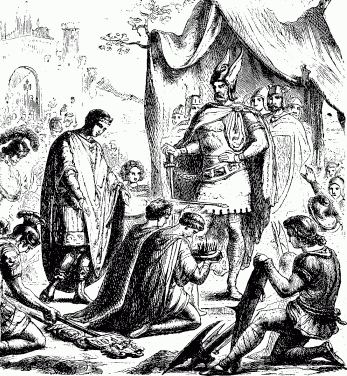
The resignation of Romulus
Augustus to the Germanic soldier Odoacer
traditionally marks the end of the Western
Roman Empire. (Commons) 

Although it is obviously difficult to determine when nations officially go kaput (the Roman empire is thought to have declined over a period of four centuries though historians take the resignation of Romulus Augustus in September 4, 476 as the moment of the western empire's fall), what is easy to ascertain is when they do, things can go sour very quickly. Take the U.S. right now with its looming debt crisis; if they indeed fail to repay their debt by October 17 this year (a little more than a week from now), it will leave a lot of creditors hanging. And in this globalised world, the knock-on effect of an unprecedented event like a U.S. debt default will leave the entire world devastated. Not to mention the fact that default will make it more difficult for America to borrow more money in the future, stifling the country's already sluggish growth rate. 

Can this be defined as the beginning of America's end (if it hasn't begun already)? And what will happen to all of us in the meantime? I wish we had Hari Seldon's psychohistory to figure that one out! But if it happens, October 17 will most decidedly be the date that future historians will choose to mark the beginning of the end of the U.S.A. They might very well also scour the ancient archives for insightful analyses written during this time period and they might probably find this one and judge it either as useful speculations or prophetic writings, depending on what happens in the next few days.

Friday, 23 August 2013

The Process of Innovation: not as straightforward as you think

Did you think all swans are white?
If you did, you've just experienced the
devastating black swan effect! (Commons)
The long vacation from medical school has allowed me to catch up on some good old reading. This month I'm trying to finish up a beautiful philosophical work titled The Black Swan by Nassim Nicholas Taleb. A prominent author and professor in epistemology (who's witty style of discussing unintuitive philosophical concepts and passionate arguments leaves me absolutely refreshed after every reading session) which is simply the study of knowledge, Nassim Taleb explores in the book the theory that he calls 'the Black Swan theory' which describes probabilistic events with the following characteristics:


  1. They are rare enough to surprise us.
  2. They have drastic consequences.
  3. They are prone to erroneous retrospective rationalisation i.e. we try to explain them away after they have happened.
A good example is the 2008 financial meltdown which resulted in a global recession which some regions like Europe are still trying to recover from. Nobody expected it, it hurt us and arrogant economists are trying to explain it away (and in some cases have no idea what they're talking about).

Without going into too much details about the book, the point is that Mr. Taleb hits on an interesting idea that I have never before imagined. In chapter eleven of the book he talks about the role of randomness in fostering scientific and technological progress in the world today. He posits that most of the designed technology today yield are simply toys that wait for an application to appear. As he aptly puts it 'solutions waiting for problems'.

We tend to apply retrospective historicism to explain that x invention was  made to solve y problem and so on in a neat chain towards today's progress. Taleb tries to squash that version of history and replaces with something less romantic but probably more grounded in reality. In fact, according to him, there might be no difference to evolution and our progress.

Evolutionary theorists posit that innovations in biological designs are actually a product of random mutations that are filtered out by environment and internal pressures such as food availability, selection during mating. He considers the laser (whose inventor was in fact ridiculed by colleagues) and Viagra (which started out as a drug for hypertension). Today we can't live without laser and its field of uses is ever expanding even today as for Viagra, it has uplifted the lives of so many men living with impotence. Or consider the internet for that matter. It was originally designed for military purposes, now we all live online.

Some companies even capitalise on such a process according to Talab; scientists can sit down in such companies and simply tinker just for the fun of it. Commercialisation comes later. Whether such a thing is feasible in the long term is unknown to me but it certainly is tantalizing to see a business model that doesn't force a scientist to become a businessman full time.

Now considering this seemingly random process of innovation, how do we make of something like '3d printing' work? Some describe it as the biggest thing since the Industrial Revolution and it honestly looks like it. You can print anything you might fancy in 3d, your face, prototypes, shoes, designs and what not. Sceptics call it a gimmick, a toy with no future, a fad. In short, the solution is so elegant, but what's the use of a layman having it in his house?
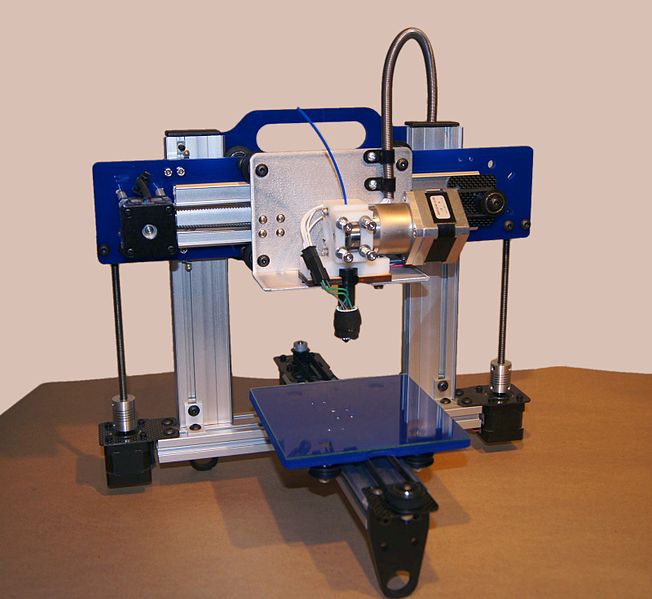
An example of a 3d printer; the ORDbot Quantum printer
(Commons)
Recently, a new desktop scanner has come out on sale that allows small items to be scanned by a laser in 3d and a computer prints a 3d copy. So we now have a desktop scanner and a home ready printer that anyone can use.  So now what? Is the technology going to be for fun or art or what. Some analysts suggest that 3d printing is only for industries and they may be right but then again, who really knows? It seems to me like we're living in the age of another growing bubble; the 3d bubble. Like the dot-com bubble of the late 1990s and early 2000s, this one might burst and make a lot of investors up on Wall street lose their breakfast.

The moral of the story is that its very hard to predict these kinds of things. Randomness has gotten the better of us and no amount of risk management will ever remove it and it is ludicrous to imagine that we will ever master risk management. Th least we can do is enjoy the ride. At least, that's what Nassim Taleb says.

Saturday, 3 August 2013

THE IT SOCIETY: In databases we trust!

Today I wish to explore the extent to which our IT-enabled society could go in making a seemingly straightforward situation more complicated and how we can make our technological expertise more grounded in reality.
Our modern society is what one would call a complex system rather than a linear system. In linear systems, outcomes between different variables are predictable with a clockwork regularity that can be described neatly with mathematical and physical principles. Examples include classical mechanics such as a swinging pendulum. Complex systems on the other hand comprise of thousands if not millions of variables which interact in a non-straightforward manners with such unpredictable outcomes that simplistic mathematical theorems that you learned in class simply fall apart. Unless you develop new ways in describing these non-linear systems (like chaos theory which I will not bother talking about here), you haven't a hope in deducing outcomes, let alone understanding the system in the first place. Classical examples include the weather. Forecasting the next day’s weather only became easier with the advent of sophisticated computers and, more importantly for today’s topic, better meteorological databases.


For many scientific disciplines, you need lots of up-to-date data. Research and survey projects are a dime a dozen nowadays but such data is useless if you don't have an efficient way to store, clean (removing input errors) and retrieve it easily. We usually rely on IT to do most of these things nowadays and we are so used to hearing from manufacturers about the benefits of these machines that we might be forgiven to believe that there aren't any catches at all with regard to IT.

Two months ago on the 15th of June I gave a review talk at my university on the subject of health information technology or HIT. I described its usefulness and the need for its implementation in the African health arena. My talk focused heavily on the history of one particular attempt in my home country of Tanzania. Many countries require all health institutions to record outpatient and inpatient details to allow abnormalities in outcomes to be tracked on a long-term basis. Typical systems employed include a centralised health database system, most of which are digital in nature. In Tanzania the database (referred to as the Health Management Information System or HMIS or MTUHA in the local language) was mostly paper-based, and still is at the district, level for a good number of years since its inception in 1993. Digitisation of the HMIS records only began at the turn of the new millennium and instead of improving data quality and efficiency in collection, IT augmentation has seemingly lowered the already poor quality of the data and has even made it more difficult for the users i.e. the health professionals to use. Researchers complain that far from being a source of life-changing knowledge, harvesting HMIS data is like looking for crops in a field of weeds. Useless!

What’s most disturbing however is the lacklustre enthusiasm that came out of the HMIS managing team based in the country’s ministry of health in the form of the following quote in a 2002 report:
“Contract out the review of the current HMIS software in the light of alternative packages available, with a view to recommending the best option for the national [health] system” (MoH, 2002:16).
In less than 2 years after digitisation was complete at the upper levels of governance, changing the system’s software was being contemplated by the team overseeing HMIS operations. More than a million U.S. dollars were used to build a broken system!

So what went wrong? The explanation I offered in the talk was that the stakeholders involved in the design and execution of the new system failed to come together in the open. Apparently the donors funding the program decided that it was better to give money directly to software vendors rather than risk losing it to the depths of government bureaucracy. But I insist that the more important reason is that these stakeholders failed to design the system to serve the health system effectively. IT is useless if the customer does not know how to use it, hence Samsung’s catchy phrase ‘designed for humans’ used in advertisements of the Galaxy series of smartphones. Although steps are now being taken to ensure that the next generation of Tanzanian health professionals are IT literate by introducing definite IT studies in the university curriculum, I think it would be better if the whole country were to prioritise IT in its national development goals just like in its neighbour Kenya which has recently seen a surge in investments from big names like IBM, Google and Hewlett Packard.

What we see here is a case of fundamental system design failure. The stakeholders forgot about the complexities of the African health system, hence the seemingly inexplicable nature of the digital HMIS’ outcome. Health workers are either too busy or too ignorant to work the gadgets. The solution is elegant but not necessarily simple; build a strong culture of IT, make people more aware of it then design the system to fit the people and not the other way around. This bottom-up approach will help us prevent building loaded but useless systems that will inhibit rather than allow us to harvest life-saving health knowledge.


You can also read my original paper here where you will also find a list of good references.

Monday, 29 July 2013

The Era of Knowledge Harvesters

In this present day and age, intellectual capital
 has increasingly taken centre stage
in the global economic theatre
(Commons, University of Erfut)
There was a time when progress in the world was measured by how much output countries could produce, be it cotton, cars, raw minerals, gross domestic output, et cetera. I think this philosophy was most pronounced immediately after the industrial revolution took off in Great Britain in the 19th century. So much that it really didn't matter whether you're a communist or an uncaring capitalist, if you didn’t make your quota then someone suffered the consequences (be it dismissal or worse).

Countries strived for better production in larger quantities for commerce and trade while seeking means to control as much of the natural resources as possible through sheer military and political might. But while all this was happening something else was occurring in the background. An exponential increase in the rate of discovery was taking place. It would have been impossible to power the industrial revolution without a knowledge base in steam engines and thermodynamics. The same goes for all the engines that came afterwards. Similarly, material sciences gave birth to new forms of metal alloys including steel which was used to make bigger and stronger structures like bridges and skyscrapers. A combination of the two and improved understanding of timekeeping allowed the creation of the railway and steam-powered ships which revolutionised commerce and trade throughout the world.

Other discoveries like the telegraph and, eventually, the telephone gave rise to the still powerful modern north Atlantic trading bloc. The practical advantages of instantaneous communications continue to be seen today with the internet, satellite and telecom industries. The knowledge market is born. Knowledge is being created every day, bought, sold, transmitted, gathered and organised every second. New methods of recalling, organising and manipulating data for whatever means and purposes are required every day by individuals and institutions and this is exactly what powers Silicon valley and the like. Our brains are designed to comprehend things in the now with a limited number of variables. But unfortunately for us, the world is composed by thousands of variables that act in a non-linear manner. It’s a complex system we’re dealing with here and our heads are simply unable to take it all in without making serious asinine acts like the 2008 global financial meltdown. And even with the assistance of humongous computing power, we are about as graceful as a bull in a china shop. Wisdom is required to navigate this complex world of ours.

Wisdom and knowledge in its many forms can be found in the most unlikely of places. Most assuredly our ancestors were as smart as we are today. They could observe, formulate hypotheses and test them for predicted outcomes. The only difference is that with time, we have made the process into an art. Whatever our forefathers could do, we can now do better. A perfection of thought and acts that has allowed our race to prosper and grow at rates never before experienced.

It has also brought forth a paradigm shift. As I said in the beginning of this essay, progress was once measured by the output of heavy industries. Now, however, heavy industries do not necessarily imply progress (to the delight of green activists I’m sure!). What we now have today is a knowledge economy that now measures progress primarily by how much intellectual capital you have. The rest can be outsourced thanks to a highly networked economy. Such a system has allowed even small countries like Israel, Rwanda and Switzerland to become highly developed (or fast growing) economies. With limited resources, they as well as many other institutions including companies are left sinking their money into people’s education. The knowledge that grows from such investments is harvested and used again for more growth. This time and era clearly belongs to the harvesters of knowledge.