Showing posts with label Innovation. Show all posts

Saturday, 27 May 2017

On Designing Relevant AI Products for Humans


Many attempts at creating effective user experiences with artificial intelligence (AI) tend to produce news worthy results but not so much in terms of upping mainstream adoption.

Routine AI use for most consumers is still not an everyday thing (broadly speaking anyway, it may not be so if you look at certain demographic groups and interest groups such as tech enthusiasts). No one’s as dependent on AI assistants in the same way as we are so dependent on, say, Word processors or Google Search or mobile devices.

Intelligent assistants are still a novelty, and that may stem from the problem of their design. Most people don’t want to converse with machines on philosophical matters (though it ought to be cool), they just need to make a reference. People don’t want virtual girls in holographic displays asking them how their day went after coming home from work. And people seem to naturally want to troll chatbots in an attempt to explore the limits of their “intelligence”, and perhaps have a laugh while at it.

In fact, the more we attempt to define AI use in the context of human specific activities, the less it is used. It is perhaps a result of our bias towards emulating the all-knowing, all-powerful and very personal/witty AI found in films like Her or in sci-fi games like Halo. This kind of cultural hinting naturally leads many people to believe that, because the AI is being presented in a very human-like fashion, then it should act like a human. The fact of the matter is that, in almost all cases, you’re probably going to see through the facade before 10mins of continuous use have elapsed.
AI simply isn’t human, and designers shouldn’t help us pretend that they are.
Instead of trying to approach the question of AI usage when designing interfaces purely from the perspective of our sci-fi fantasies (who knows the future anyway?), we could perhaps start with the user; what do they actually need? They probably might not need an AI with a built-in personality.
They might instead need an AI that can do small but useful stuff efficiently and reliably. Successful intelligent agents that do just that usually lack any form of personality or similar bells and whistles. 

Take Google’s strategy; Google’s assistant and intelligent products haven’t a hint of personality besides the voice used for their voice search functionality. This cuts out a lot of cultural and psychological baggage from the conversation. Since the product clearly appears as a machine, people will not lead themselves to believe that their assistants can do human-like stuff (sparing the occasional witty answers and trivia). This can be beneficial because the user isn’t distracted by the product’s attempts at sounding human. The user is instead empowered without him/her even realising it. It just works.

I used to think building an assistant as cold and impersonal as Google Now would be a bad move, but I can now see the logic when comparing Google Now to the competition. Cortana looks so lively, and yet she disappoints me precisely because you keep looking for the human-likeness as it all but disappears with continued usage. Ditto Siri. I get so distracted by their apparent witty personality that I can’t seem to get at their actual functionality. Why do I need a witty robot in the house?

By far, the most interesting thing that Google has ever added to it’s Google Now app was no less impersonal, but it was extremely useful IMO. Now on Tap is able to recognise elements displayed at anytime on a phone, allowing a search to be done without leaving any given opened app. If it doesn’t detect what you want, you can simply highlight it and it would search for that. It is a perfect design; minimalistic, useful and brutally impersonal. It just works.

Intelligent apps shouldn’t be built to seem explicitly human; they should be built to get some actual work done. And they should do it without distracting. I know this might not be the kind of interesting personal robot some of us would have imagined, but it is probably the only way to make things less awkward between man and machine. The uncanny valley is not a place that you’d like your app to end up in, certainly not the rest of the consumer AI market and industry.

AI is still an emerging technology, like the Internet before it went mainstream. We are still trying to understand how to integrate the technology into the normal, everyday workflow of average human beings. Human-AI UX design choices may prove to be what makes or breaks consumer AI applications. The potential rewards for successfully breaking the design problem are tantalising; designers must keep seeking the perfect problem-solution fits that real people might care about and design around that.


Monday, 15 May 2017

The Source of Innovation: The Open Commons Alternative


A Public Library; important venture but not a lucrative venture
Last week’s best read on the web from the contrary-to-my-personal/popular-beliefs section was, in my opinion, this.

The author has some interesting insights into the sources of America’s innovation, how said innovation comes mostly from government funding and, most importantly, how the private sector tends to NOT produce innovation, or even downright discourages it.

If you’ve been to a fair number of entrepreneurship and startup events, you’ll probably have heard the oft spoken claim that the private sector is the source of innovation. However, the guardian article I argues to the contrary; government is the source of all major innovations that exist today, and it is most certainly true. Nothing can outcompete government spending on risky ventures, especially private capital.

Unlike private capital, the spenders of public funds usually tend to invest in long term projects that are either too expensive to manage with private capital, will take too long to build with little in terms of direct monetary returns, are not prone to scarcity (despite being desirable) and therefore not profitable (for example national infrastructure for utilities such as water and sewerage). These kinds of ventures are extremely risky but important nonetheless. Just not important enough in the context of capitalism.

Having a system that can easily handle this kind of spending without being held accountable by the principles of capitalism (though obviously this does not mean such a system is exempt from the principles of sustainability and accountability) is what leads to the concept of public spending on public goods (this also includes military spending for the public good that is national defence, a necessary evil unfortunately).

However, having said all this, I’d also add that, although this kind of system of spending is important in the creation of public goods, it would be perhaps myopic to accept the that the MODERN STATE ARCHITECTURE is the only way logical to guarantee and execute public goods creation. There are other ways of deriving the same via different means that are, arguably, more open and accountable than classic states (or supranational entities for that matter).

Wikipedia comes to mind here: it is neither a government nor a private entity. It is a commons: a resource that is owned by the community. It’s resource is knowledge, freely created, curated and edited by ordinary people for anyone who can access it. Its funding is derived from generous donations (like taxes, but without the legal coercion). And, most importantly, it works without being directly dependent on government, or private capital. It is the middle ground of innovative possibilities that we all want.

Why do I fuss over this? Simple, I want my innovation to be guilt-free, clean, without any stain that taints government-sourced innovation (military R&D for war, sometimes without accountability) and private capital (questionable intents, inaccessibility through artificial scarcity and over pricing). 

Innovation that is purely and directly owned by the community is there in the wild. In fact, due to the fact that all innovations can ultimately be traced to the individual minds of ordinary but brilliant folks, we can at least agree to accept that the need for a different approach that doesn’t involve introducing potentially perverse incentives (government or private in nature) to these people is in order.

A collective (commons-based) investment scheme for open innovation might be the third alternative that we desperately need. The public spending versus private capital discourse should not blind us to this if we really want the march of innovation to continue to thrive and sustain itself. There is also space to talk about expanding this approach to create a directly ruled, commons-based system of government, but that’s probably a topic for best suited for another day.

Tuesday, 19 November 2013

Teaching with Robots

Last week while perusing the net for news I happened to chance upon this BBC article and I have to say, it grabbed my attention completely. The article talks about a recent Kickstarter project that successfully managed to achieve its funding goal to design and produce two robots called Bo and Yana.

At first glance these rather cute robots may look like ordinary children's playthings but they are actually for a serious purpose that is far reaching in importance. While truly made for children from 5 years and above, these robots can be programmed by the child to do many sorts of things (like acting out a story). The child essentially becomes a hacker while playing, learning how to conceptualise programming with languages like Scratch. Awesome!

The robots reflect the philosophy of their maker, Play-i, and indeed many education experts in the modern world today; in the post-computer era, must it not be a priority to educate children to become not only able to manage computing devices but also know how to program such devices? Indeed, this may not be as far fetched as us trying to teach children not just to read other people's books and papers, but also how to pick up a pen and trace letters, words and finally ideas on a piece of paper. Such knowledge requires mastering language and the same goes for computing.

Some may dismiss this idea as irrelevant to the modern child but perhaps they wouldn't dismiss it if they understood what actually drives computers. It is a language that bodes evil for many children unfortunately and it is called mathematics. Therefore learning more about computers and programming should make you a better math student, right? The idea is tantalizing and is endorsed by many luminaries in the mathematical field. For good or ill, our thinking is being shaped by these thinking machines just as much as we shape their creation. And Play-i's Bo and Yana are a testament to that end.

Friday, 23 August 2013

The Process of Innovation: not as straightforward as you think

Did you think all swans are white?
If you did, you've just experienced the
devastating black swan effect! (Commons)
The long vacation from medical school has allowed me to catch up on some good old reading. This month I'm trying to finish up a beautiful philosophical work titled The Black Swan by Nassim Nicholas Taleb. A prominent author and professor in epistemology (who's witty style of discussing unintuitive philosophical concepts and passionate arguments leaves me absolutely refreshed after every reading session) which is simply the study of knowledge, Nassim Taleb explores in the book the theory that he calls 'the Black Swan theory' which describes probabilistic events with the following characteristics:


  1. They are rare enough to surprise us.
  2. They have drastic consequences.
  3. They are prone to erroneous retrospective rationalisation i.e. we try to explain them away after they have happened.
A good example is the 2008 financial meltdown which resulted in a global recession which some regions like Europe are still trying to recover from. Nobody expected it, it hurt us and arrogant economists are trying to explain it away (and in some cases have no idea what they're talking about).

Without going into too much details about the book, the point is that Mr. Taleb hits on an interesting idea that I have never before imagined. In chapter eleven of the book he talks about the role of randomness in fostering scientific and technological progress in the world today. He posits that most of the designed technology today yield are simply toys that wait for an application to appear. As he aptly puts it 'solutions waiting for problems'.

We tend to apply retrospective historicism to explain that x invention was  made to solve y problem and so on in a neat chain towards today's progress. Taleb tries to squash that version of history and replaces with something less romantic but probably more grounded in reality. In fact, according to him, there might be no difference to evolution and our progress.

Evolutionary theorists posit that innovations in biological designs are actually a product of random mutations that are filtered out by environment and internal pressures such as food availability, selection during mating. He considers the laser (whose inventor was in fact ridiculed by colleagues) and Viagra (which started out as a drug for hypertension). Today we can't live without laser and its field of uses is ever expanding even today as for Viagra, it has uplifted the lives of so many men living with impotence. Or consider the internet for that matter. It was originally designed for military purposes, now we all live online.

Some companies even capitalise on such a process according to Talab; scientists can sit down in such companies and simply tinker just for the fun of it. Commercialisation comes later. Whether such a thing is feasible in the long term is unknown to me but it certainly is tantalizing to see a business model that doesn't force a scientist to become a businessman full time.

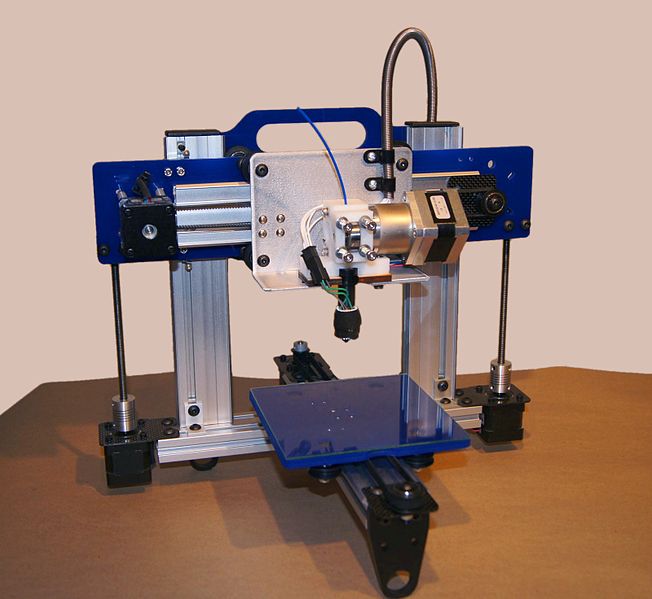
Now considering this seemingly random process of innovation, how do we make of something like '3d printing' work? Some describe it as the biggest thing since the Industrial Revolution and it honestly looks like it. You can print anything you might fancy in 3d, your face, prototypes, shoes, designs and what not. Sceptics call it a gimmick, a toy with no future, a fad. In short, the solution is so elegant, but what's the use of a layman having it in his house?
An example of a 3d printer; the ORDbot Quantum printer
(Commons)
Recently, a new desktop scanner has come out on sale that allows small items to be scanned by a laser in 3d and a computer prints a 3d copy. So we now have a desktop scanner and a home ready printer that anyone can use.  So now what? Is the technology going to be for fun or art or what. Some analysts suggest that 3d printing is only for industries and they may be right but then again, who really knows? It seems to me like we're living in the age of another growing bubble; the 3d bubble. Like the dot-com bubble of the late 1990s and early 2000s, this one might burst and make a lot of investors up on Wall street lose their breakfast.

The moral of the story is that its very hard to predict these kinds of things. Randomness has gotten the better of us and no amount of risk management will ever remove it and it is ludicrous to imagine that we will ever master risk management. Th least we can do is enjoy the ride. At least, that's what Nassim Taleb says.