Wednesday, 12 April 2017

Our World is Changing: How Might We Master Change?

The Libyan Revolution, an example of change gone wrong. Image shows a tank outside the city of Misrata (Wikimedia Commons)
Change is guaranteed in Nature. Matter undergoes state transitions, ecosystems suffer violent episodes and recover and your body turns over your red blood cells every 90 days.
Even aspects of our personhood are in a constant state of flux; from childhood to puberty, from adulthood to old age, what we might consider as ‘us’ never stays quite the same. We always seem to find an alien of sorts to cringe at when staring at records of our past selves.

Far from being an existential conundrum, changes in the self is evidently our most precious characteristic, imparting us a degree of adaptability that has allowed us to survive a world where Change rules supreme. Besides that, in a world where humanity is immutable in belief and structure, would we discover anything new? Would we discover that tenacious form of ‘human spirit’?

And yet, despite all this, we also happen to live in a world where change receives very mixed reception. Few of us embrace change as we would embrace life itself. Even when most people would prefer change over the status quo, there are always those who would prefer the past over the present and its futures, no matter what.

The concept of ‘traditions’, ‘customs’ and perhaps even animism evolved partly out of our natural desire to always be connected to the past. This is something to celebrate, but tradition that fails to acknowledge change tends to breed instability in the long run as pressure inevitably builds up between the forces for change and the forces of status quo.

Therefore, in a world gripped in ever morphing new challenges, it is imperative that we seek to master the science of change through the creation of “tools for mastering Change”. Our present tools and structures for managing ourselves (i.e. governments, institutions, policies, etc) thrive on creating artificial stability. They are fragile. A single parameter change can quickly and violently end things (the global debt market is but one example) and we would be left helpless and unprepared, all ripe for extinction.
Any fool can create change and the tools for manifesting change already exist; the internet is the tamer kind and modern weaponry is the deadliest of them all.
The astute reader will note, however, that I draw a distinction between tools for creating change versus mastering change. Any fool can create change and the tools for manifesting change already exist; the internet is the tamer kind and modern weaponry is the deadliest of them all. What we lack are the tools to manage and understand change. Consequently, while we can establish change amongst ourselves (revolutions, protests for policy change, lobbying) we are COMPLETELY blind as to question of what those changes might entail and how to implement them without killing ourselves in the end.

To put it simply, while it is easy for us to implement said change, it is difficult for us today to manage that change once it is out there in the wild. We are fragile, glass figures that easily shatter and shatter ourselves in the process, all in the name of unquestioned, unmanaged, undisciplined change.

Mastering change is about more than merely predicting what lies ahead (an unreliable science in the hands of fools), its about embracing change just as we would like to live a good life without becoming hurt in the process. It is about us as a species learning to drive confidently into this brave new world of ours while not under influence of our naive selves.

Monday, 10 April 2017

Good Governance Made Simple

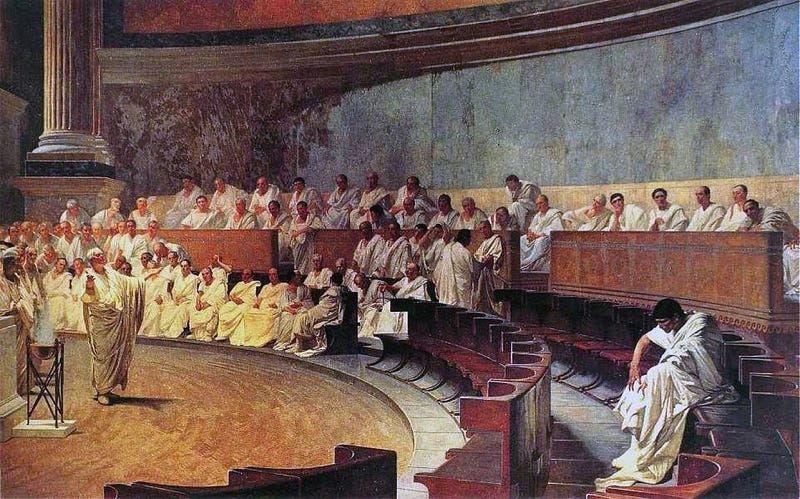
Painting depicting Ancient Rome’s Senate

I wrote this short essay on a whim: is it possible to reduce the concept of “good governance” to its most succinct components such that a severely distracted millennial could comprehend it instantly and even perhaps make something of it all? What follows is my take. You be my judge.
I remember a time when the term ‘good governance’ was being thrown around a lot. Often it was used as a placeholder for modern liberal democratic states, classically thought of as the pinnacle of human civilisation and progress. Indeed, that may be so but are all nascent liberal democracies destined to a life of prosperity? The evidence is shaky at best, non existent at worst. Perhaps it is no wonder then that the original term seems to have died a quiet death over the turn of the last decade. 

Good governance these days seems to live up there with the rest of the world’s pies in the sky. People are on the lookout for something different, if the election of Trump is anything to go by. It’s unfortunate that things have turned out this way. Good governance is still arguably important to all of us, despite the up tick in global cynicism towards institutions that can potentially support it. However, perhaps the idea is in need of rejuvenation, now more than ever, before it can become a rallying point for good, honest people to build awesome and relevant institutions again.

So, first off, what exactly constitutes good governance any way? Depending on who you talk to, good governance abides by several principles such as accountability, transparency, citizen participation, efficiency and responsiveness in giving service, rule of law, and inclusiveness. So far so good, but can we make all this any simpler? Let’s start from the perspective of people.

If people cannot natively sense that they are benefiting from an institution’s presence and activities, then the stage is all set for a reset in the form of tumultuous, revolutionary resets. The key thing then is obvious: a structure that does not serve cannot sustain its own existence, or the people who depend on it for that matter. So, through reasoning, we can conclude that defined, efficient structures that actually meet demand with all the trappings of good governance are desirable. Great!

However, structures are only as good as the weakest link in them and the weakness stems from, again, people. This weak link emerges in the form of general illiteracy and the general inability to comprehend the structure, not only for the purpose of using it, but also for the purpose of improving. You cannot make progress with a mechanism you cannot comprehend, let alone try to comprehend without access to basic cognitive support (education, open knowledge, rigorous, open public discourse, open information networks, open tools, etc).

Therefore, from the above we identify two main components that need to be in place in order to even begin to implement good governance: a defined structure that can be documented in an open manner, is agreed upon and understood by every stakeholder to the maximum, and lends itself to renewal through intelligent, informed self-amendment by ALL involved stakeholders (I default to the belief that that which may affect all must be decided by all). Structure and knowledge; these, I would therefore argue, are the very foundations of good governance at any level of human organisation.

Sunday, 9 April 2017

Free & Open Technology: A Law unto Itself & why only You can defend it

“Liberty guiding the People” by Eugène Delacroix, 1830

Hello folks, it's been a while since I posted something here. Figured it was high time I made atoned my sins and rejuvenate this blog. I have a Medium page which you can check out here. There's plenty of stuff over there but you can also stay here to look around at some of my more ancient musings. I'll try to see if I can bring this blog back from the dead. Until then, enjoy! Abraham

The nation state is what it is because it was enabled by technology. Society’s values, infused with nationalistic enthusiasm and vigour, especially in the early part of the last century during the Great World Wars, helped play a role to instigate the initial enabling, but after that, technology played an even greater role in sustaining the rise of the nation state.

And then a cultural revolution happened: society’s values slowly changed over the later part of the last century, becoming more liberal and open to radical ideas and thought. It was slow in the sense that relatively few people here and there across the United States and the rest of the world truly subscribed to the new cultural movements. Many ‘ordinary’ folks at the time still considered such people to be ‘queer’, strange or downright unnatural and that sentiment was reflected in their attitude towards such radicals.

Amidst all this, the 1% rule was already at work; these small groups of radical thinkers spawned not just weird cultural thought. Some also spawned incredible technological innovations for the masses (people like Richard Stallman come to mind here). Moreover, these technological tinkerers of the time infused their work with their radical values, spawning the Free and Open Source Software movement (FOSS). By the time the internet and web matured into useful technologies, the technological hippies were more than ready to take over the Earth.


The creation of FOSS challenged orthodox thinking on scarcity and copyright. It insulted conventional laws and corporate thinking. The war on Free and Open source and open innovation by the real world’s laws and institutions since then has become a war of attrition, but the gains made by the open source movement have been unmistakable and substantial.

Nevertheless, FOSS may have won many battles, but the war has yet to be decisively won. Open encryption is the latest assault on conventional thinking with regards to national/international security versus privacy issues. In fact, as the title of this article suggests, open encryption has enabled technology, and by extension the society that uses it, to become a law unto itself; world governments, despite their best efforts at reducing the effectiveness of open encryption to police the world and wage cyberwars, have found it more and more difficult to penetrate the increasingly sovereign Internet’s defences. This does not in any way mean that technology is fool proof (it is reasonably secure until the next open source enabled security alert) nor should it be misconstrued as an ‘evil’ development,however much the UK’s Home office would have you believe.

To call secure and private communications bad would be like calling a fence/wall and home security together with trespass laws bad. It simply isn’t. In fact, the recent terrorist attack at Westminster, London, UK had more to do with the utter incompetence of the government’s monitoring of the perpetrator than his use of WhatsApp. But the latter proved to be an irresistible scapegoat I suppose.
Take the recent successful repulsion of net privacy laws in America and the truth becomes obvious: the global war over authority is just beginning. Open technology (and societal values encoded in it) is a law unto itself but the nation state is pushing back. It is up to all of us to make the next move.

FOSS is a very, very political statement. So let’s send a message to the lumbering giants of the real world by building things that resist control by them today.
“Value your freedom or you will lose it, teaches history. ‘Don’t bother us with politics,’ respond those who don’t want to learn” ~ Richard Stallman